Your Back Doesn't Have to Hurt: A Physician's Guide to Prevention Through Core Strength
Back pain is one of the most common reasons people see a physician, miss work, and limit their physical activity. It is also, in a significant proportion of cases, preventable. Not through rest, not through avoidance, and not through the kind of passive treatment that most people default to when their back first starts causing problems. The most effective long-term intervention for back pain is building the strength and stability that keeps it from developing in the first place, and one of the most overlooked investments in long-term physical longevity.
The challenge is that most people's understanding of what that means is about thirty years out of date.
Sit-Ups Are Not a Core Strength Exercise
When most people think about core training, they think about sit-ups and crunches. It is an understandable association: these movements involve the abdominal muscles, they have been a fixture of fitness culture for generations, and they feel like they are doing something. The problem is that sit-ups and crunches involve repeated spinal flexion under load, which is precisely the movement pattern most associated with disc stress and injury, particularly in the lumbar spine. Ironically, the exercise most commonly prescribed for back health is among the least appropriate choices for people with existing back problems, and not an ideal foundation for back pain prevention even in healthy individuals.
Real core training is not about flexing the spine. It is about stabilizing it. The core musculature, which includes the deep abdominals, the multifidus, the pelvic floor, the diaphragm, and the muscles of the hips and glutes, functions primarily as a system that resists movement and transfers force between the upper and lower body. Training it to perform that function means training it under conditions that challenge stability, not conditions that repeatedly fold and unfold the spine.
The Exercises That Actually Work
The following movements represent the foundation of evidence-based core training for back pain prevention. Each one trains the core the way it actually functions: as a stabilizer.
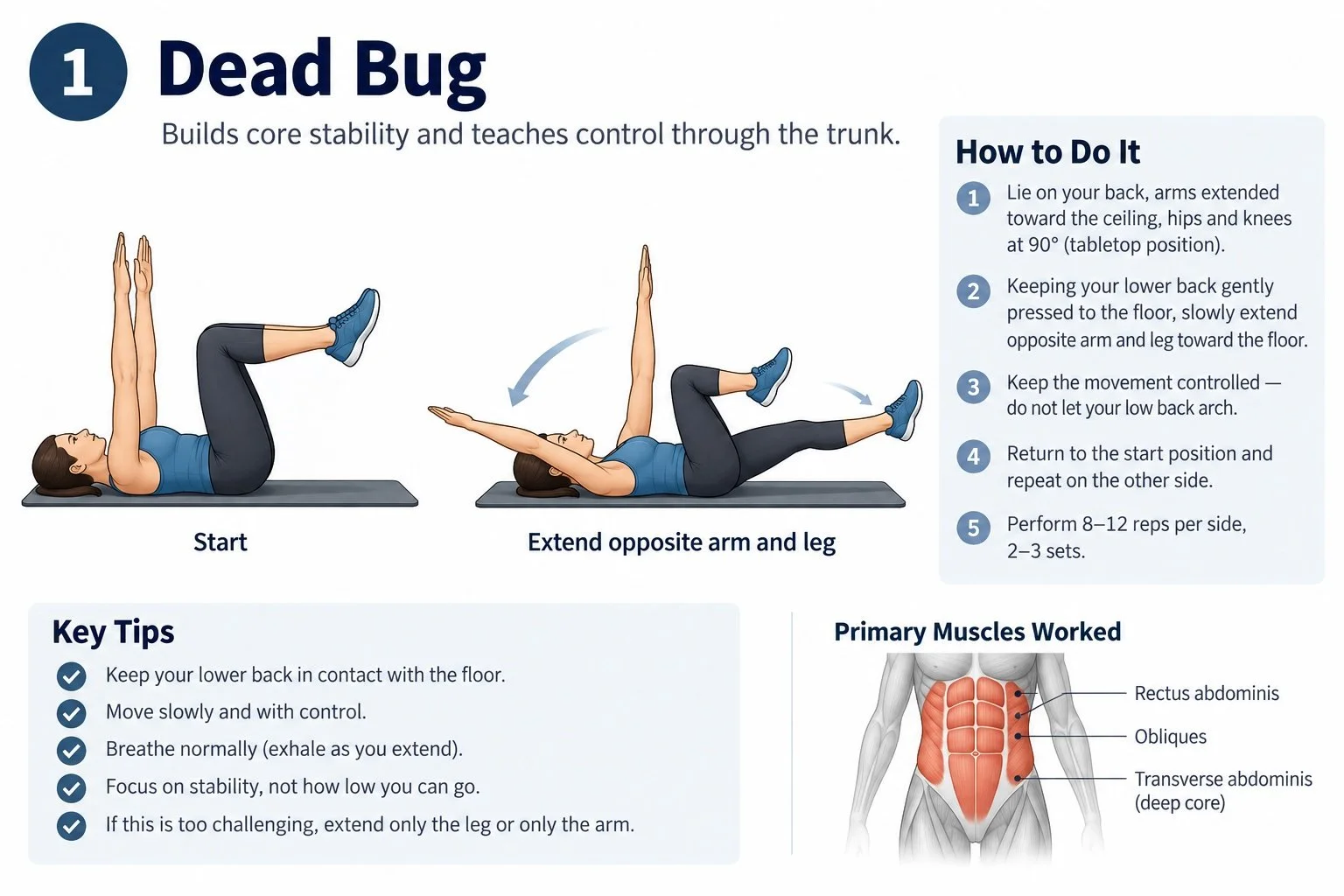
Dead Bug Lying on your back with your arms extended toward the ceiling and your knees bent at ninety degrees, you slowly lower one arm and the opposite leg toward the floor while keeping your lower back pressed firmly against the ground, then return and repeat on the other side. The temptation to let the lower back arch away from the floor is where the core engagement happens. Resisting that arch is the exercise. The dead bug trains the deep stabilizers of the lumbar spine in a position that is safe for virtually every fitness level.
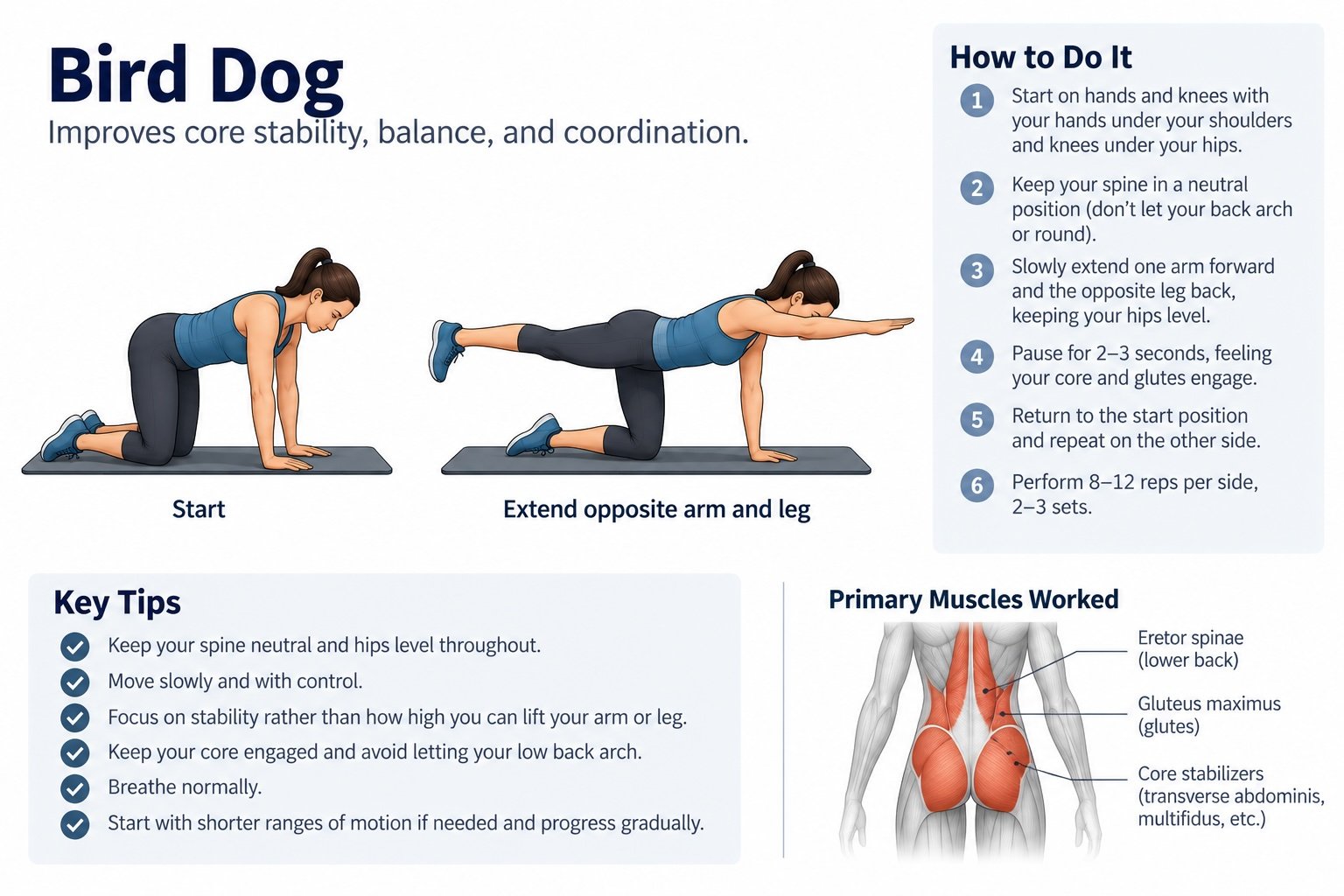
Bird Dog Starting on hands and knees, you extend one arm and the opposite leg simultaneously, hold briefly, and return without rotating the hips or spine. Like the dead bug, the work is in the resistance: the core must fire to prevent the pelvis from dropping or twisting as the limbs extend. This movement also trains the glutes and the muscles of the thoracic spine, making it more than a simple core exercise.
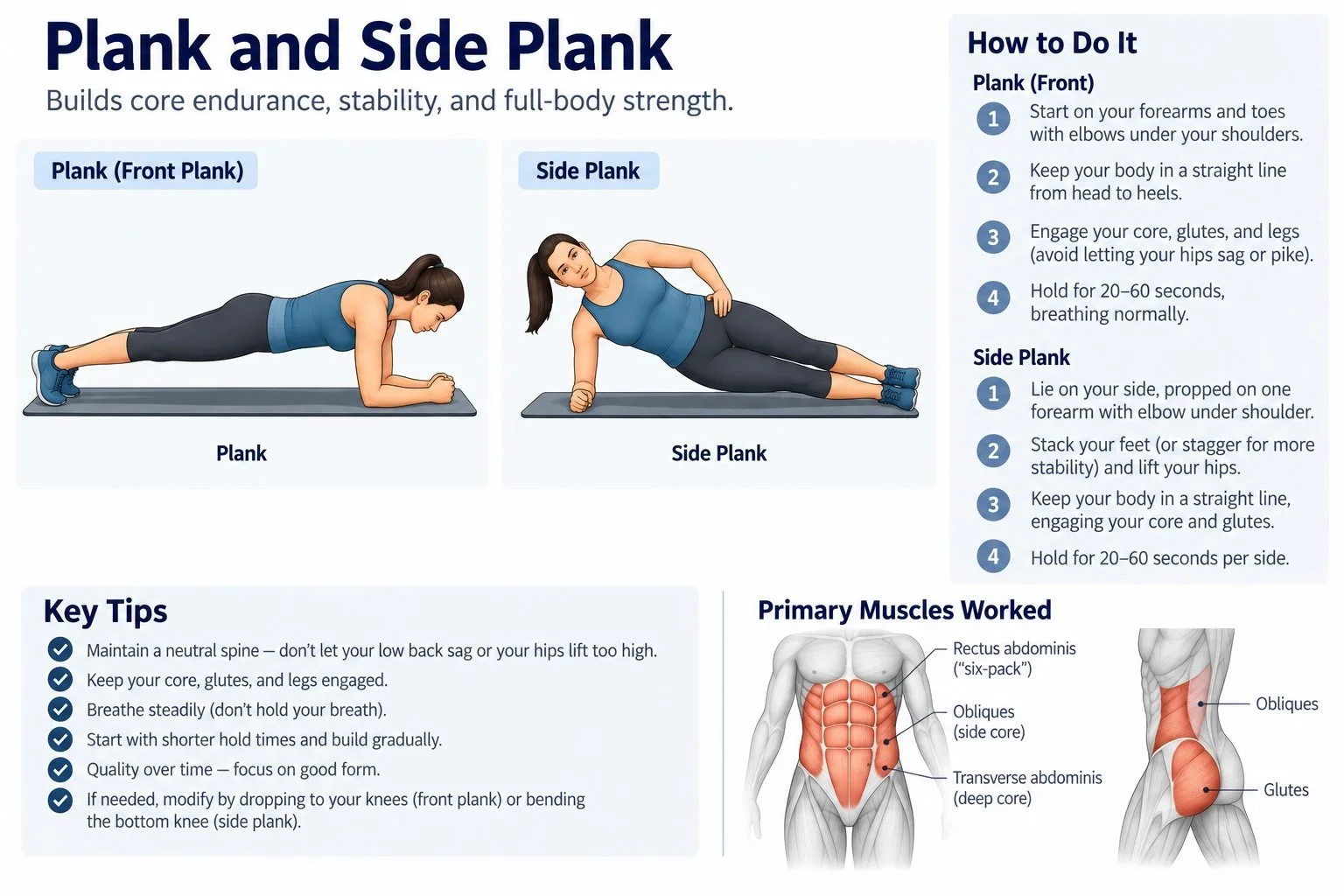
Plank and Side Plank The plank trains anti-extension, the core's ability to resist the spine from sagging under load. The side plank trains anti-lateral flexion, the ability to resist the spine from bending sideways. Both are essential. A plank held with correct form, meaning a straight line from head to heel with no sagging hips or elevated backside, is significantly more demanding than it looks and requires engagement of the entire trunk musculature.
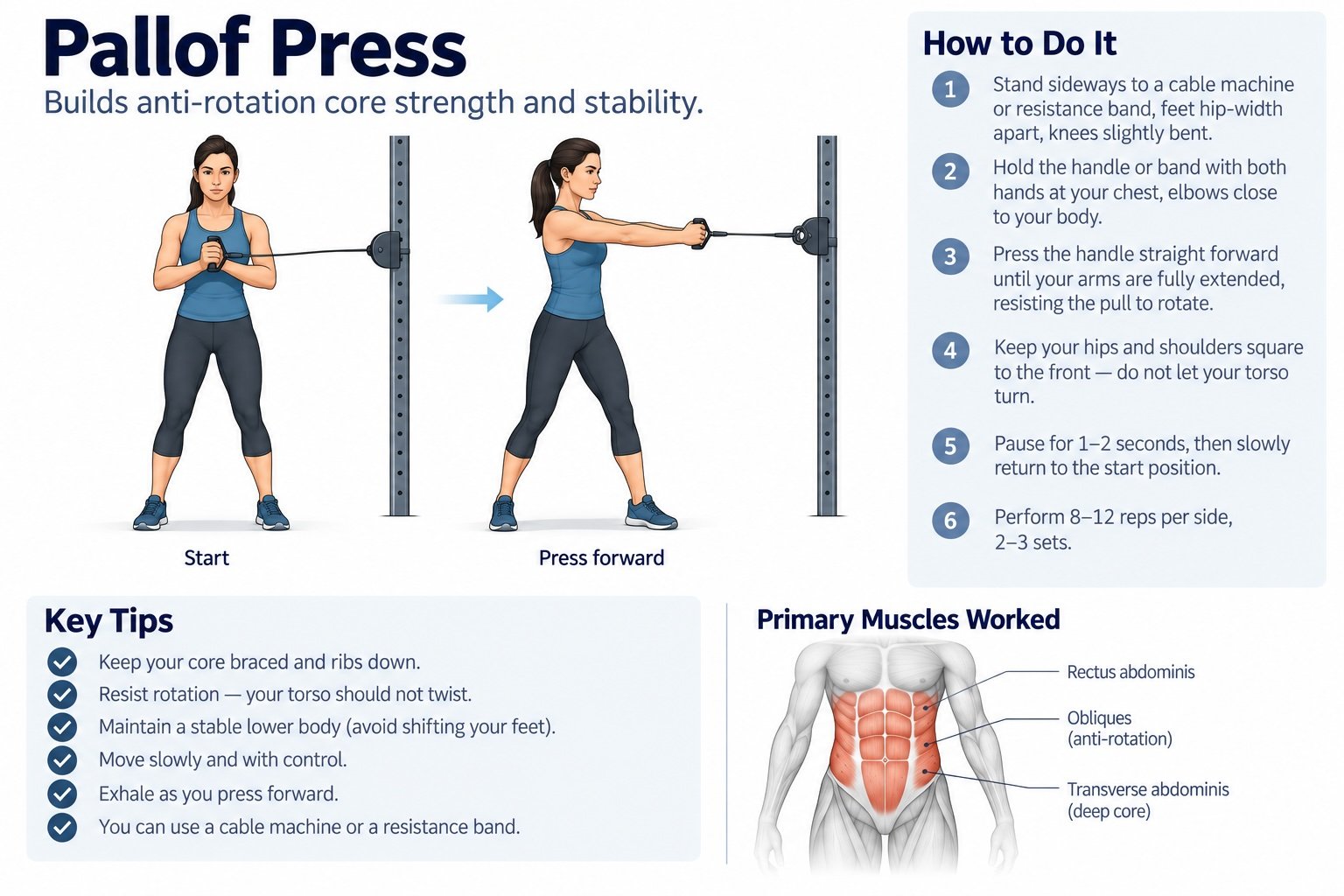
Pallof Press Using a cable machine or resistance band anchored at chest height, you stand perpendicular to the anchor point, hold the handle at your chest, and press it straight out in front of you, then return. The rotational force pulling you toward the anchor is what you are resisting throughout the movement. The Pallof press trains anti-rotation, arguably the most functional and most undertrained dimension of core stability, and directly addresses the kind of rotational stress the spine encounters during most real-world activities.
Why Unilateral Training Is Core Training
One of the most important and least appreciated principles in back pain prevention is this: any time you remove the stability of a second limb, you force the core to work harder. Unilateral exercises, movements performed one limb at a time, are therefore core exercises by definition, regardless of whether they are targeting the arms, legs, or trunk. This principle has significant implications for how we structure training, and is one we apply consistently in personalized preventive care.
Lower Body
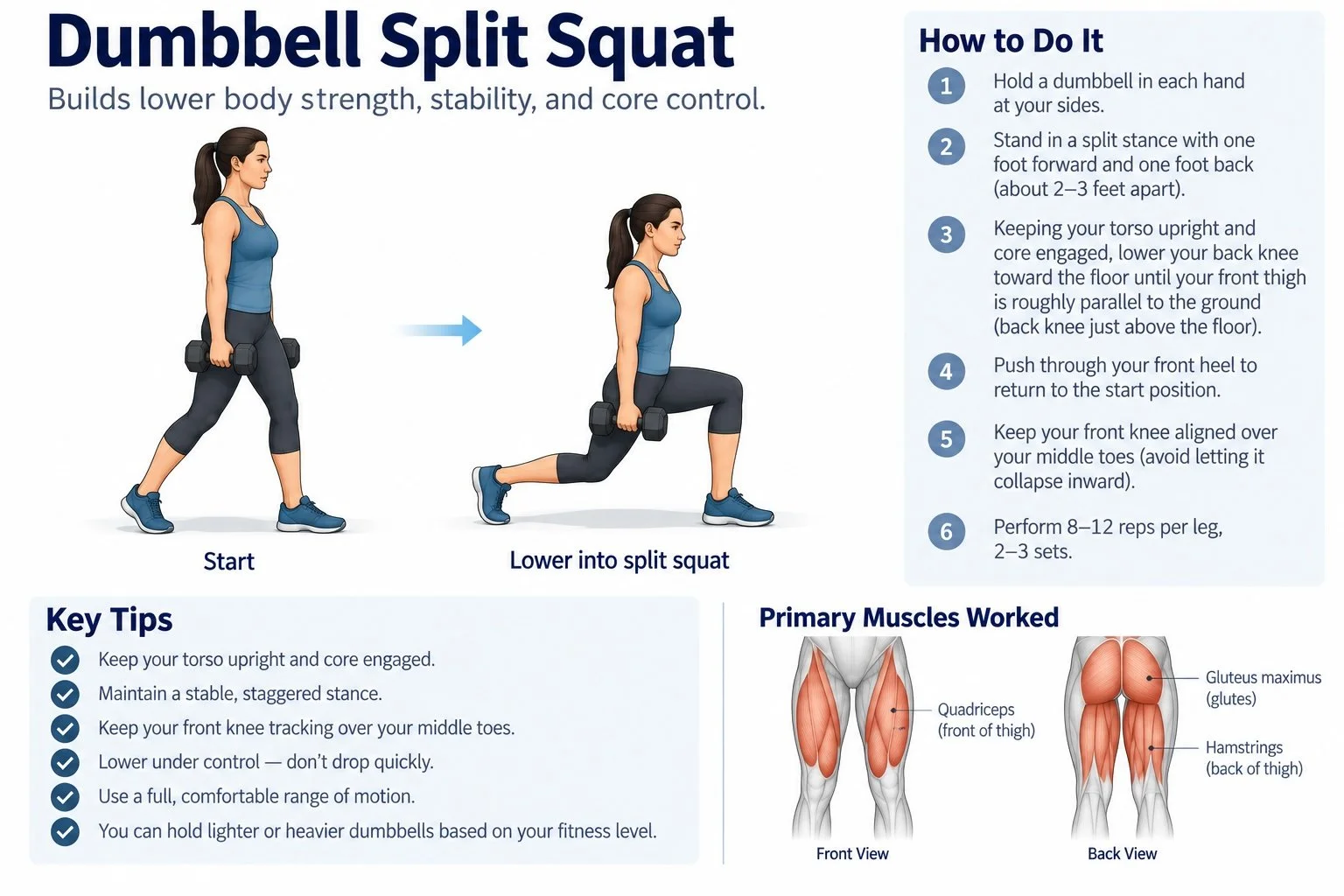
Dumbbell Split Squat With one foot forward and one foot back, holding a dumbbell in each hand, you lower the back knee toward the floor and return. The split stance removes the bilateral stability of a conventional squat, immediately demanding greater core engagement to prevent the pelvis from rotating or the torso from leaning excessively. The dumbbell load, held at the sides rather than on the back, also reduces spinal compression compared to a barbell squat, making this an accessible and effective option for patients with existing lower back sensitivity.
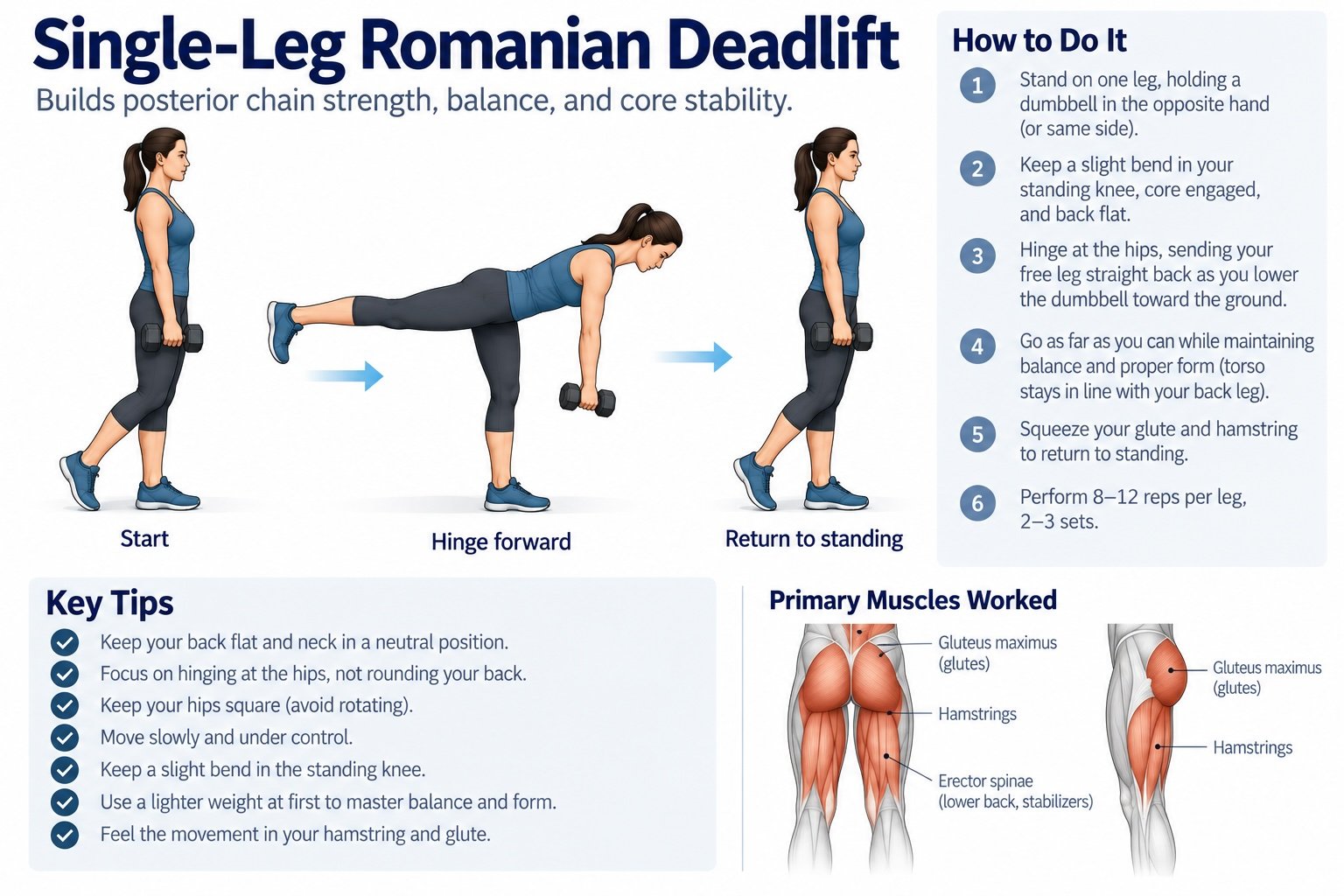
Single-Leg Romanian Deadlift Balancing on one leg, you hinge at the hip and lower a dumbbell toward the floor while the non-standing leg extends behind you for counterbalance. This movement is as much a balance and core stability exercise as it is a posterior chain exercise. The demand on the hip stabilizers and the lateral core to prevent the pelvis from dropping is substantial, and the feedback is immediate: if your core is not engaged, you will know it.
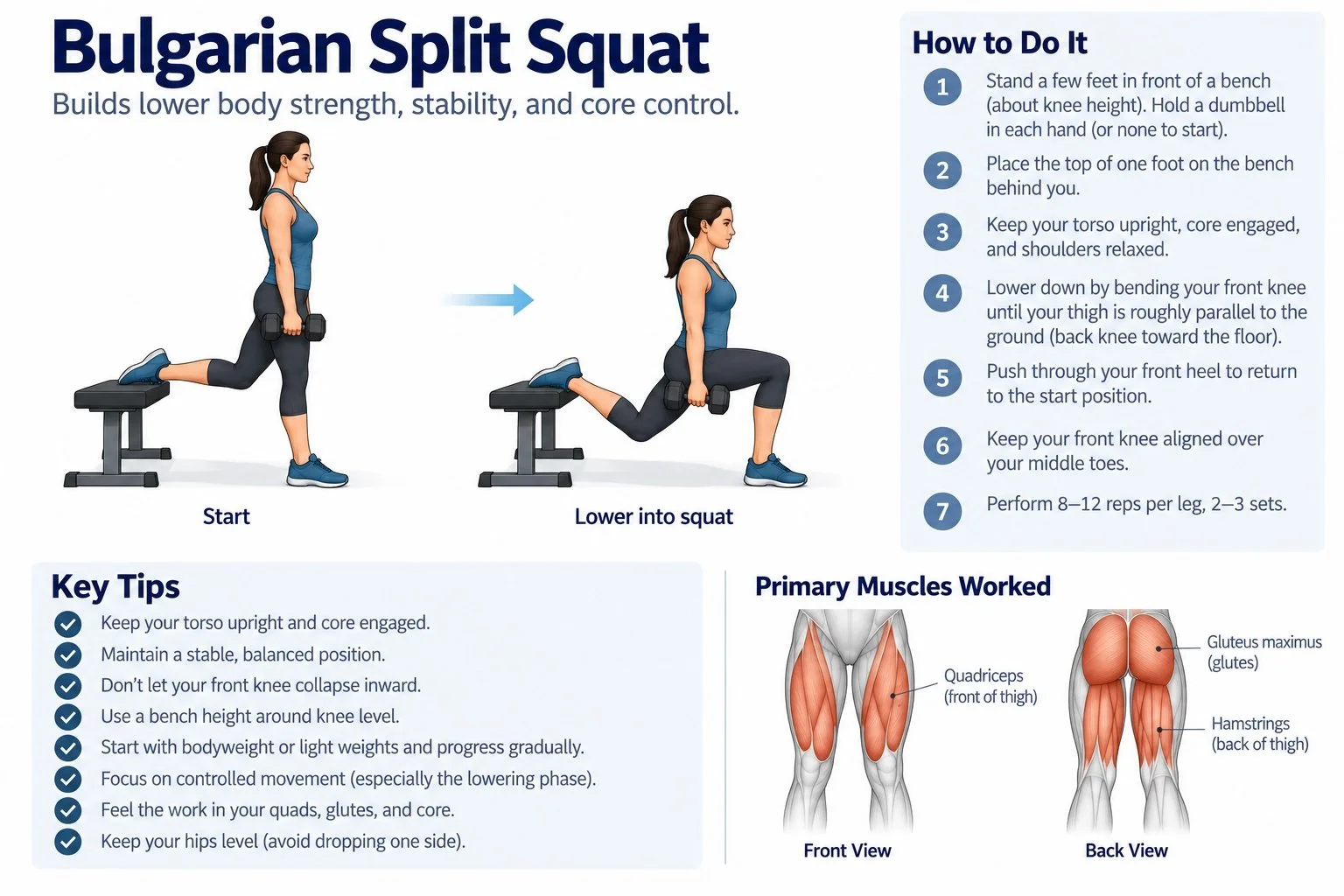
Bulgarian Split Squat With the rear foot elevated on a bench and a dumbbell in each hand, you lower the back knee toward the floor and return. More demanding than the standard split squat, this movement trains each leg independently through a greater range of motion, with a correspondingly higher core stability requirement. The combination of single-leg loading, elevated rear foot, and dumbbell resistance makes this one of the most efficient lower body exercises available, and one with a direct benefit to lumbar stability.
Upper Body
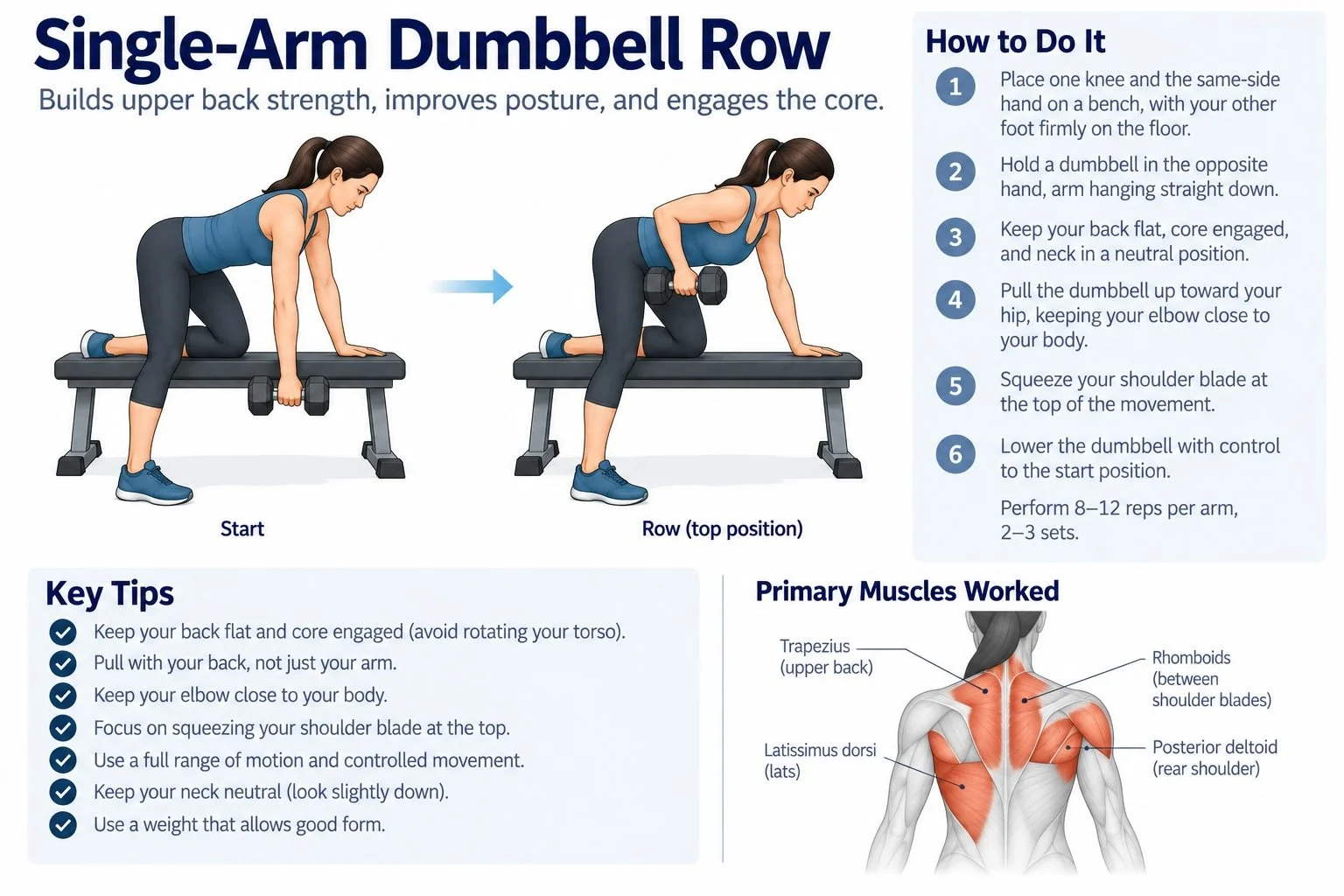
Single-Arm Dumbbell Row With one hand and knee braced on a bench and a dumbbell in the opposite hand, you row the weight toward your hip while keeping the spine neutral and the pelvis level. The rotational force created by the unilateral load must be resisted by the entire core, making this as much a core stability exercise as a back exercise. The temptation to rotate the torso to generate momentum is where the core engagement lives. Resisting it is the point.
Addressing the Upper Back: The Neglected Half of the Equation
Lower back pain receives the most attention, but upper back and neck pain is nearly as prevalent and increasingly common among people who spend significant time at a desk or looking at screens. The condition sometimes referred to as "tech neck," a forward head posture with rounded shoulders and a compressed cervical and upper thoracic spine, is the predictable result of sustained positions that the muscles of the upper back are not strong enough to counteract. It is among the most common musculoskeletal complaints we see in concierge medicine settings among the executives and professionals who make up a significant portion of our patients.
The fundamental problem is a strength imbalance. Most people train the muscles they can see in the mirror: the chest, the front of the shoulders, and the biceps. The muscles of the upper back, the rhomboids, the middle and lower trapezius, and the rear deltoids, are chronically underworked in most training programs and chronically overstretched by hours of forward-leaning posture. The result is a musculoskeletal system that is pulling the head and shoulders forward without sufficient posterior strength to pull them back.
The correction is straightforward in principle: train the upper back with the same intention and volume that most people bring to chest and shoulder training. In practice, this means adding horizontal pulling movements, vertical pulling movements, and specific exercises that target the muscles responsible for scapular retraction and posterior shoulder strength.
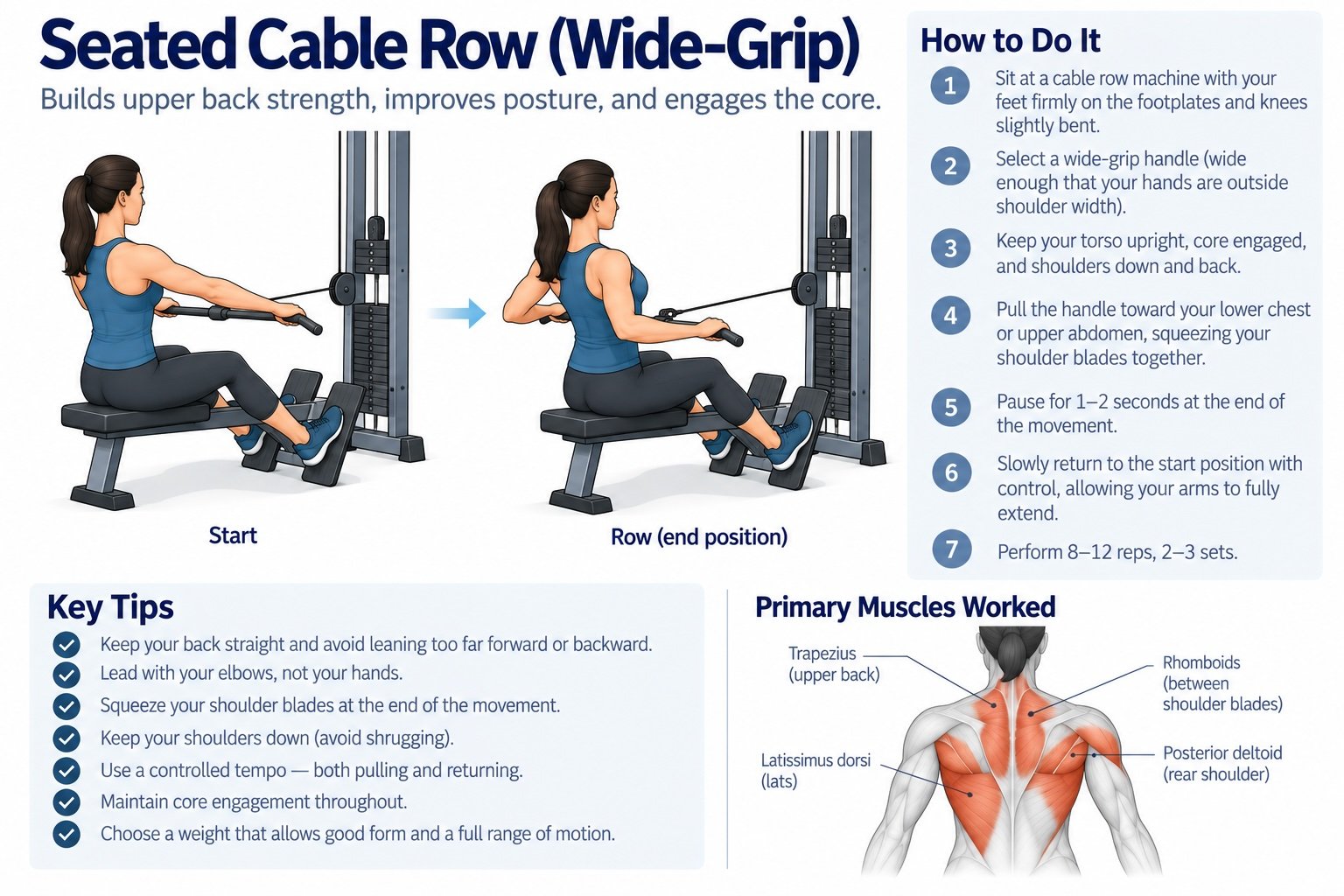
Rows Rows in their various forms are the cornerstone of upper back training. A standard seated cable row or dumbbell row trains the middle back and biceps through a horizontal pulling pattern. A wide-grip row shifts emphasis toward the upper back and rear deltoids, directly targeting the muscles most responsible for pulling the shoulders back into alignment. Including both grip widths in a training program ensures comprehensive coverage of the muscles that counteract forward posture.
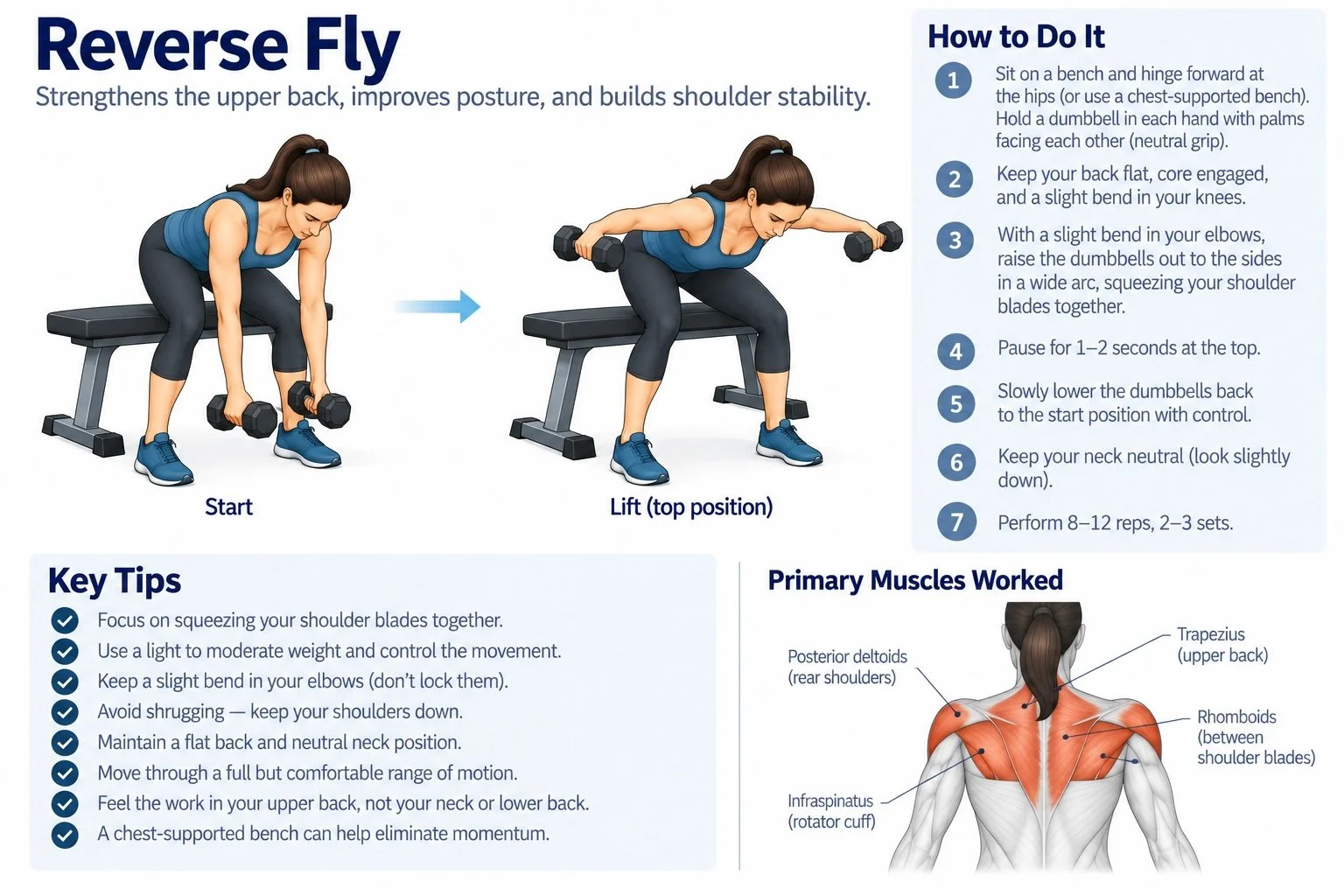
Reverse Fly With dumbbells in hand and a slight forward lean at the hips, you raise the weights out to the sides with a slight bend in the elbows, squeezing the shoulder blades together at the top. This movement directly targets the rear deltoids and rhomboids, the muscles most responsible for preventing the rounded-shoulder posture associated with desk work and tech neck. It is a relatively simple exercise that is frequently omitted from training programs, and its absence is felt in the posture of almost everyone who sits at a desk for a living.
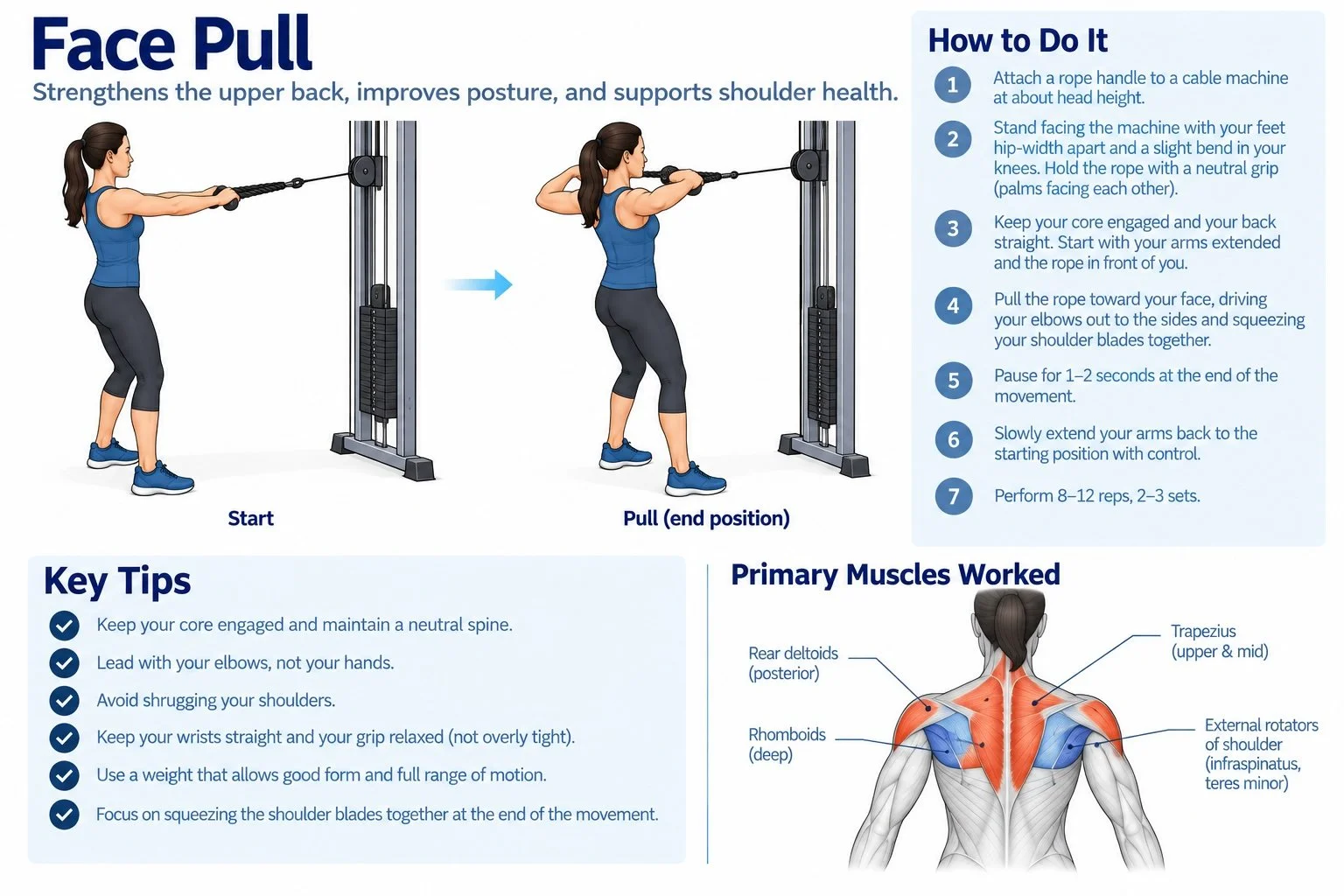
Face Pull Using a cable machine with a rope attachment set at upper chest or face height, you pull the rope toward your face with the elbows high and wide, finishing with the hands beside the ears. The face pull directly trains the external rotators of the shoulder and the rear deltoids, muscles that are almost universally weak in people with tech neck posture. It is one of the most corrective exercises available for the upper back and should be a staple in any program that prioritizes postural health.
Putting It Together
Back pain prevention is not a single exercise or a single approach. It is the cumulative result of training the core to stabilize the spine, building the posterior chain strength to support movement under load, correcting the upper back weakness that accumulates from sedentary and screen-heavy work, and doing all of this consistently over time.
The good news is that the exercises that accomplish this are accessible to most fitness levels, require minimal equipment, and integrate naturally into any existing training program. The even better news is that the return on investment is significant. A spine that is well-supported by strong, balanced musculature is a spine that is substantially less likely to cause problems, at the desk, in the gym, or anywhere else.
Although many of these movements appear straightforward, I strongly recommend spending dedicated time with an experienced and knowledgeable trainer before performing them independently. Correct form is not a minor detail in core and back training. It is the difference between an exercise that protects the spine and one that stresses it. A qualified trainer can identify compensations and movement patterns that are invisible to the untrained eye and nearly impossible to self-correct without feedback. The investment in proper instruction at the outset pays dividends for years, particularly in a longevity-focused training context where the goal is building a body that performs well for decades, not just months.
If you are currently experiencing back pain, please consult a physician or physical therapist before beginning a new exercise program. The principles above are oriented toward prevention in otherwise healthy individuals, and appropriate modifications may be needed depending on your specific situation.
Dr. Schraga is a concierge physician at Crescendo MD, a longevity-focused concierge medicine practice serving the San Francisco Bay Area. He specializes in personalized preventive care, executive health, and longevity medicine for high-performing individuals and families.
