Stem Cell Therapy for Orthopedic Injuries: A Reality Check
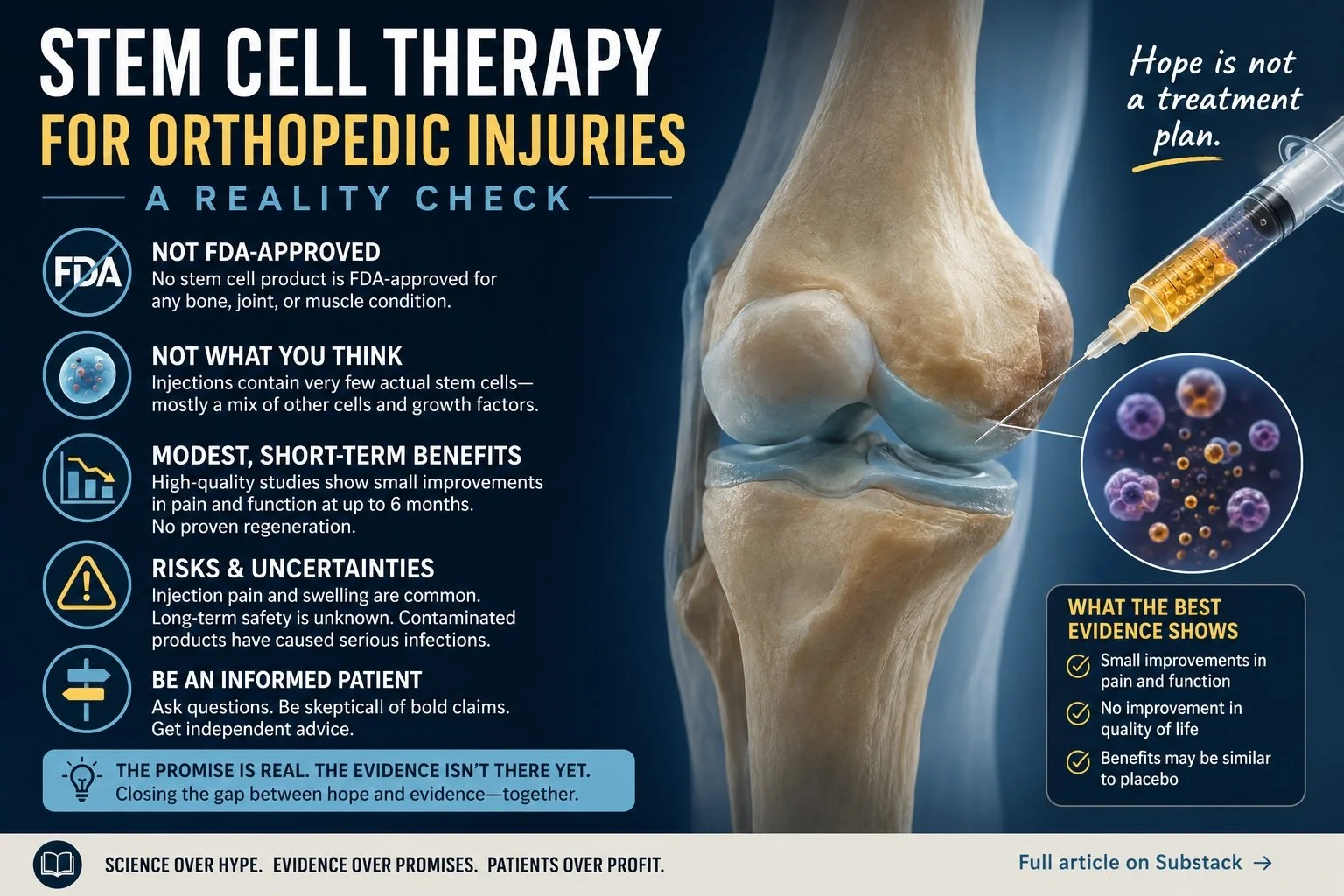
Stem Cell Therapy for Orthopedic Injuries: A Reality Check
If you've been dealing with chronic knee pain, a torn meniscus, or a joint injury that just won't heal, chances are you've come across an ad promising that stem cells can fix it, maybe even regrow lost cartilage or repair damaged tissue. The marketing is slick, the testimonials are compelling, and the clinics offering these treatments are everywhere.
But what does the science actually say? Let's break it down.
No Stem Cell Product Is FDA-Approved for Any Orthopedic Condition
This is worth repeating: not a single stem cell product has been approved by the FDA for treating any bone, joint, or muscle condition. The only FDA-approved stem cell products are derived from umbilical cord blood and are used exclusively for blood cancers and disorders like leukemia and sickle cell disease.
So what are all these clinics injecting?
Most use one of the following:
- Bone marrow aspirate concentrate (BMAC): Your own bone marrow is drawn (usually from the pelvis), concentrated, and injected into the injured area. This is the most common approach. It's permitted under FDA rules because it uses your own tissue with minimal processing, but "permitted" is not the same as "proven effective."
- Adipose (fat)-derived cells: Fat tissue is harvested via liposuction, processed, and injected. Fat contains more mesenchymal stromal cells than bone marrow, but more extensive processing pushes these products into stricter FDA regulatory territory.
- Umbilical cord, placental, and amniotic tissue products: These are allogeneic (from a donor) products marketed aggressively as containing stem cells. The FDA has been clear: no injectable perinatal tissue product is licensed for musculoskeletal use, and these products are being used outside their regulatory framework.
The "Stem Cell" Label Is Misleading
Here's something most patients, and even some clinicians, don't realize: the preparations being injected contain very few actual stem cells.
True stem cells are defined by their ability to self-renew and differentiate into multiple tissue types. In bone marrow, these cells make up roughly 0.005% to 0.01% of all nucleated cells, or about 1 in every 10,000 to 20,000 cells. What you're actually getting is a complex soup of various cell types, growth factors, and signaling molecules. Scientists increasingly prefer the term "mesenchymal stromal cells" rather than "stem cells" because the latter implies regenerative powers that these preparations haven't been shown to possess.
What Does the Research Actually Show?
The most rigorous evidence to date comes from a 2025 Cochrane systematic review(the gold standard in evidence synthesis), which analyzed 25 randomized controlled trials involving 1,341 patients with knee osteoarthritis. The findings were sobering:
- Stem cell injections provided a small improvement in pain and function compared to placebo at up to 6 months.
- There was no demonstrated improvement in quality of life or overall treatment success.
- The clinical significance of the small benefits remains unclear.
A 2026 meta-analysis of 28 randomized trials reinforced these findings, concluding that MSC therapies serve a primarily symptom-modifying rather than structure-modifying role. In other words, they might help you feel a bit better temporarily, but they aren't rebuilding your joint.
Perhaps most telling: one of the best-designed studies compared bone marrow concentrate injections with simple saline (salt water) injections in patients with knee osteoarthritis in both knees. Both groups improved similarly. This raises the uncomfortable question of whether the benefits patients experience are largely a placebo effect.
The Regeneration Myth
This is where the gap between marketing and reality is widest.
Can stem cells regrow a torn meniscus? In rats and rabbits, certain types of stem cells have shown some ability to promote partial meniscal tissue repair. In humans? Only a handful of small clinical studies exist, and none have demonstrated that an injection can regrow a torn or surgically removed meniscus.
Can they regenerate cartilage? Some studies have reported increased cartilage volume on MRI after stem cell treatment. But when researchers looked more closely, they found that while volume might increase, cartilage quality did not significantly improve. It also remains unknown whether injected cells actually become functional cartilage cells or whether any benefit comes from their anti-inflammatory signaling effects, which is a very different mechanism than true regeneration.
Can they rebuild bone? Stem cells have been studied as supplements to fracture healing, but robust evidence for standalone bone regeneration via injection is lacking.
The bottom line: the cells used in clinical practice are fundamentally different from the purified, laboratory-expanded cells used in the animal studies that showed regenerative potential. Extrapolating from a rat study to a human knee is a very large leap.
The Wild West of Stem Cell Clinics
The stem cell clinic industry has exploded, and with it, a troubling amount of misinformation. A study examining nearly 900 practice websites advertising stem cell therapy for musculoskeletal conditions found that 96% contained at least one false or misleading claim, with an average of nearly five false claims per site.
Common misleading claims include:
- Promising tissue regeneration without evidence
- Claiming FDA approval that doesn't exist
- Overstating the number or potency of stem cells in their preparations
- Downplaying risks
Stem Cell Tourism: A Growing Concern
Patients who can't find (or afford) treatments domestically are increasingly traveling abroad, particularly to Latin America, Asia, and Eastern Europe, for stem cell procedures. Regulatory frameworks in many of these countries are inconsistent or nonexistent, and the quality and safety of the products used are often unknown.
The Risks Are Real
While autologous (your own cells) stem cell therapy appears to have a generally acceptable short-term safety profile, it's not without risks:
- A 2026 meta-analysis found that MSC injections were associated with significantly higher rates of injection-site pain and joint swelling compared to controls.
- Long-term safety data are insufficient. We simply don't know what happens years down the road.
- Contaminated products have caused serious harm. A CDC/FDA investigation identified 20 patients across eight U.S. states who developed serious bacterial infections after receiving umbilical cord blood-derived products marketed as stem cell treatments. Nineteen of the 20 required hospitalization. Testing revealed that 65% of unopened product vials were contaminated with bacteria.
So Where Does This Leave Us?
Stem cell therapy for orthopedic injuries is not snake oil. There is real science here, and the field is evolving. But the current state of evidence supports, at best, modest and short-term symptomatic improvement, not structural regeneration. The gap between what is being marketed and what has been proven is enormous.
If you're considering stem cell therapy for a joint injury, here's what to keep in mind:
1. Be skeptical of bold claims. If a clinic promises to regrow your cartilage or heal your meniscus with an injection, that claim is not supported by current evidence.
2. Ask about FDA status. No stem cell product is FDA-approved for orthopedic use. If a provider implies otherwise, that's a red flag.
3. Understand what you're getting. Ask exactly what is being injected, how it's processed, and what evidence supports its use for your specific condition.
4. Consider the cost. These treatments are almost never covered by insurance and can cost thousands of dollars out of pocket.
5. Talk to your orthopedic surgeon or sports medicine physician. Get an independent opinion from someone who doesn't have a financial interest in selling you the treatment.
The promise of regenerative medicine is real, but we're not there yet, at least not for most orthopedic conditions. Responsible clinicians and researchers are working to close the gap between hope and evidence. In the meantime, patients deserve honesty about what these treatments can and cannot do.
Dr. Schraga is a concierge physician at CrescendoMD in the San Francisco Bay Area who focuses on prevention, longevity, and personalized primary care. He writes here about how emerging science and innovation are shaping the future of health.
References:
Investigation of Bacterial Infections Among Patients Treated With Umbilical Cord Blood–Derived Products Marketed as Stem Cell Therapies. JAMA Network Open. 2021. Hartnett KP, Powell KM, Rankin D, et al.Case
American Medical Society for Sports Medicine Position Statement: Principles for the Responsible Use of Regenerative Medicine in Sports Medicine. Clinical Journal of Sport Medicine : Official Journal of the Canadian Academy of Sport Medicine. 2021. Finnoff JT, Awan TM, Borg-Stein J, et al.Guideline
Balancing Safety and Innovation for Cell-Based Regenerative Medicine. The New England Journal of Medicine. 2018. Marks P, Gottlieb S.Opinion
The Evidence Basis and Regulatory Framework for Biologic Augmentation of Foot and Ankle Surgeries. The Journal of the American Academy of Orthopaedic Surgeons. 2026. Haupt ET, Shi GG, Shapiro SA.
Nonoperative and Operative Soft-Tissue, Cartilage, and Bony Regeneration and Orthopaedic Biologics of the Shoulder: An Orthoregeneration Network (ON) Foundation Review. Arthroscopy : The Journal of Arthroscopic & Related Surgery : Official Publication of the Arthroscopy Association of North America and the International Arthroscopy Association. 2021. Condron NB, Kester BS, Tokish JM, et al.Review
Cell Therapy in Orthopaedics: Where Are We in 2019?. The Bone & Joint Journal. 2019. Rodeo SA.Review
